
Online Class: ABCs of Geometry
no certificate
with CEU Certificate*
-
15Lessons
-
17Exams &
Assignments -
8Hours
average time -
0.8CEUs
Course Description
Mastering Geometry: Deciphering the Language of Shapes and Spaces
Geometry, the branch of mathematics that explores the nuances of shapes and spaces, is not just confined to textbooks. It permeates our daily life, influencing everything from architectural marvels to intricate art patterns. This course is designed to immerse learners into the dynamic world of geometry, helping them not only understand its core concepts but also appreciate its ubiquitous presence in our surroundings.
Course Essence
Spanning a meticulously crafted curriculum, this course aims to transcend beyond theoretical knowledge. Through engaging readings, interactive lessons, challenging quizzes, and avenues for independent exploration, students are facilitated to develop a holistic understanding of geometry. Furthermore, an array of curated websites will augment the learning experience, allowing students to delve deeper into specific topics at their own pace.
By the culmination of this course, students will possess a robust foundation in geometric principles, enabling them to decipher the world through a geometrical lens. They will hone the ability to:
-
Perceive Geometry's Daily Implications: Recognize how geometry seamlessly integrates into various professions, the universe, our homes, and even the synthetic constructs of our world.
-
Identify Geometric Figures: From basic shapes like triangles and rectangles to more complex forms such as kites and prisms, students will become adept at naming and visualizing a plethora of figures.
-
Analyze Properties of Shapes: Delving deeper, students will discern the intricate properties that define each shape - right angles, parallel sides, number of corners, and more.
-
Establish Relationships Between Figures: Develop the acumen to deduce relationships between different shapes. For instance, understanding how every rectangle is essentially a parallelogram characterized by a right angle.
-
Adopt a Deductive Geometric Mindset: Progressing through the Van Hiele levels of geometric thought, students will cultivate the skill to reason and deduce geometric concepts, paving the way for rigorous proofs.
Course Roadmap
-
Lesson 1 - Geometry in Our World: Initiating the journey by illuminating the omnipresence of geometry in our surroundings.
-
Lesson 2 - Learning All About Shapes: An extensive exploration of various geometric figures and their distinguishing features.
-
Lesson 3 - Tessellations: Discover the mesmerizing patterns formed by repeating shapes without any overlaps or gaps.
-
Lesson 4 - Symmetry: Dive into the world of balanced proportions and understand the harmony in geometric figures.
-
Lesson 5 - Pentominoes: Venture into the realm of geometric puzzles and their intriguing configurations.
-
Lesson 6 - Three Dimensional Shapes: Elevate the learning from 2D to 3D, unraveling the complexities of spatial figures.
-
Lesson 7 - Perimeter: Grasp the concept of boundaries and their measurements.
-
Lesson 8 - Area: Delve into the space enclosed within geometric boundaries.
-
Lesson 9 - If-Then Statements: Master the foundational logic statements pivotal for geometric proofs.
-
Lesson 10 - Area of Three-Dimensional Objects: Measure the space occupied by 3D entities.
-
Lesson 11 - Translations, Reflections, Rotations: Understand the transformative actions that can alter a shape's position or orientation without changing its form.
-
Lesson 12 - Classifying Shapes by Properties: Learn to categorize shapes based on inherent characteristics.
-
Lesson 13 - Proofs and Abstract Thinking in Geometry: Harness abstract thought processes to validate geometric concepts.
-
Lesson 14 - Geometry in Our Universe: Marvel at how the cosmos is a magnificent testament to geometric principles.
-
Lesson 15 - Geometry in Professions: Realize the indispensable role of geometry in various vocations, from architecture to design.
Steer Your Curiosity into Mastery
Geometry is more than a subject; it's a lens to perceive the intricacies of our world. Whether you're a student aiming for academic excellence, an enthusiast curious about the world's designs, or a professional seeking to integrate geometric principles into your work, this course promises to be an enlightening experience. Unveil the secrets of shapes and spaces and recognize the symphony of geometry echoing throughout our universe.


- Completely Online
- Self-Paced
- Printable Lessons
- Full HD Video

- 6 Months to Complete
- 24/7 Availability
- Start Anytime
- PC & Mac Compatible
- Android & iOS Friendly
- Accredited CEUs

Course Lessons
Lesson 1 - Geometry in Our World
 Lesson 1 Video
 Lesson discussions: Reasons for Taking this Course
 Complete Assignment: Motives for Taking this Course
- Assessment: Lesson 1 - Geometry in Our World
Lesson 2 - Learning All About Shapes
- Lesson 2 Video
- Assessment: Lesson 2 - Learning All About Shapes
Lesson 3 - Tessellations
- Lesson 3 Video
- Assessment: Lesson 3 - Tessellations
Lesson 4 - Symmetry
- Lesson 4 Video
- Assessment: Lesson 4 - Symmetry
Lesson 5 - Pentominoes
- Lesson 5 Video
- Assessment: Lesson 5 - Pentominoes
Lesson 6 - Three Dimensional Shapes
- Lesson 6 Video
- Assessment: Lesson 6 - Three dimensional shapes
Lesson 7 - Perimeter
- Lesson 7 Video
- Assessment: Lesson 7 - Perimeter
Lesson 8 - Area
- Lesson 8 Video
- Assessment: Lesson 8 - Area
Lesson 9 - If-Then Statements
- Lesson 9 Video
- Assessment: Lesson 9 - If… Then Statements
Lesson 10 - Area of Three-Dimensional Objects
- Lesson 10 Video
- Assessment: Lesson 10 - Area of Three Dimension Objects
Lesson 11 - Translations, Reflections, Rotations
- Lesson 11 Video
- Assessment: Lesson 11 - Translations, Reflections, Rotations
Lesson 12 - Classifying Shapes by Properties
- Lesson 12 Video
- Assessment: Lesson 12 - Classifying Shapes by Properties
Lesson 13 - Proofs and Abstract thinking in Geometry
- Lesson 13 Video
- Assessment: Lesson 13 - Proofs and Abstract thinking in Geometry
Lesson 14 - Geometry in Our Universe
- Lesson 14 Video
- Lesson discussions: Geometry and People
- Assessment: Lesson 14 - Geometry in Our Universe
Lesson 15 - Geometry in Professions
- Lesson 15 Video
- Lesson discussions: About This Course; Rate This Course; Program Evaluation Follow-up Survey (End of Course); Course Comments
- Assessment: Lesson 15 - Geometry in professions
- Assessment: The Final Exam
Learning Outcomes
- Recognize the role of Geometry in the real world.
- Recognize geometric shapes.
- Understand tessellations.
- Apply the concept of symmetry in geometry.
- Recognize pentominoes.
- Solve geometry problems of three dimensional shapes.
- Calculate the perimeter or any shape.
- Calculate the area of any shape.
- Calculate the area of three dimensional objects.
- Understand translations, reflections, and rotations in geometry.
- Classify shapes by properties.
- Create proofs in Geometry.
- Understand how Geometry is prevalent in our universe.
- Demonstrate mastery of lesson content at levels of 70% or higher.
Additional Course Information
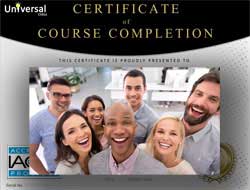
- Document Your Lifelong Learning Achievements
- Earn an Official Certificate Documenting Course Hours and CEUs
- Verify Your Certificate with a Unique Serial Number Online
- View and Share Your Certificate Online or Download/Print as PDF
- Display Your Certificate on Your Resume and Promote Your Achievements Using Social Media

Choose Your Subscription Plan
No Certificate / No CEUs
This course only
| Includes certificate | X |
| Includes CEUs | X |
| Self-paced |

|
| Instructor support |
|
| Time to complete | 6 months |
| No. of courses | 1 course |
Certificate & CEUs
This course only
| Includes certificate |
|
| Includes CEUs |
|
| Self-paced |
|
| Instructor support |
|
| Time to complete | 6 months |
| No. of courses | 1 course |
Certificates & CEUs
Includes all 600+ courses
| Includes certificate |
|
| Includes CEUs |
|
| Self-paced |
|
| Instructor support |
|
| Time to complete | 12 Months |
| No. of courses | 600+ |
Certificates & CEUs
Includes all 600+ courses
| Includes certificate |
|
| Includes CEUs |
|
| Self-paced |
|
| Instructor support |
|
| Time to complete | 24 Months |
| No. of courses | 600+ |
Student Testimonials
- "I thought the most helpful was the part that explained about the faces, edges, and different shapes." -- Amanda F.
- "I flunked 7th and 8th grade math. learned what I should have learned in this course. Thanks, just thanks." -- Irene T.
- "As an introductory course I think the course was above excellent and a very high quality teacher. I liked the methodology used to teach geometry because it clarified a lot of areas for me. The course was structured so that I could learn the concepts and not worry too much about performance. I have to admit that this is the first math/science class that I have thoroughly enjoyed." -- Francisco M.
- "I found the whole program to be helpful. It gave me a better understanding of geometry and the world of geometry." -- Alexis B.
- "All of it was very helpful, it was very well explained." -- Betty G.
- "All of it the course was great. The instructor is great." -- Barry S.
- "Good job." -- Isaiah H.
- "The instructor was very helpful and reachable in doing this class over the period of time it took for me to complete it." -- Greg K.
- "The instructor was very helpful." -- Abigail N.
Related Courses
-
 35 hours
3.5 CEUs
Precalculus 101
+ More Info
35 hours
3.5 CEUs
Precalculus 101
+ More Info
-
 21 hours
2.1 CEUs
Applied Statistics 101
+ More Info
21 hours
2.1 CEUs
Applied Statistics 101
+ More Info
-
 8 hours
0.8 CEUs
Teaching Grammar to ESL Students
+ More Info
8 hours
0.8 CEUs
Teaching Grammar to ESL Students
+ More Info
-
 35 hours
3.5 CEUs
Statistics 101
+ More Info
35 hours
3.5 CEUs
Statistics 101
+ More Info
-
 7 hours
0.7 CEUs
Introduction to Logic
+ More Info
7 hours
0.7 CEUs
Introduction to Logic
+ More Info
-
 12 hours
1.2 CEUs
Business Math 101
+ More Info
12 hours
1.2 CEUs
Business Math 101
+ More Info
-
 14 hours
1.4 CEUs
Pre-Algebra 101
+ More Info
14 hours
1.4 CEUs
Pre-Algebra 101
+ More Info
-
 22 hours
2.2 CEUs
ABCs of Algebra
+ More Info
22 hours
2.2 CEUs
ABCs of Algebra
+ More Info
-
 17 hours
1.7 CEUs
Basic Math 101
+ More Info
17 hours
1.7 CEUs
Basic Math 101
+ More Info
Loading...



Follow Us Online