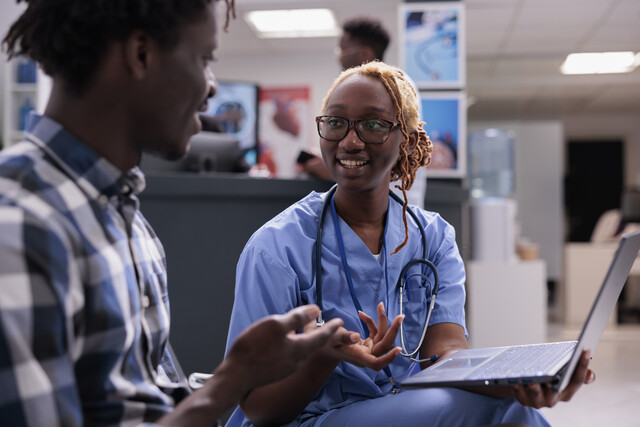

This class is for people who want to start a career in health care. After successful completion of the class, students will be able to work in nursing homes or hospitals as a nurse aide trainee. With some experience it is possible to go to work for a home health agency as well. You will be taught medical, physical, emotional, and psychological aspects of patient care. Learning to be a good care giver is important, and this course will help you excel into being a great care giver. Special needs of the elderly or disabled patient require skilled knowledge. Start learning care giving skills today. You will be able to take care of patients without difficulty. Enroll Today.
Nurse aides are the front-line workers in nursing homes and hospitals. The well-being of a nursing home resident or hospital patient depends not only on the skills of the nurse aide, but also on the relationship that develops between the nurse aide and the resident / patient. U.S. Federal regulations require that all nurse aides, who work in hospitals or nursing homes, that participate in Medicare and Medicaid, complete a State-approved training program, pass a competency exam, and receive certification from the State in which they are employed within the first four months of employment. State-approved training programs must be a minimum of 75 hours and include 16 hours of supervised clinical training. This class prepares you to be hired by a hospital or nursing home and work as a nurse aide trainee but does not count towards the mandatory federal requirement. The required federal educational hours are often paid for, and provided by, your employer during work hours. This class is an excellent value. You can make more money on your first day of work than you spent on your tuition. You will enrich your life and those you take care of. Jobs in the health care field are in high demand and this is a great way to get started on a profitable career. Enroll Now.
Course Requirements
You should have a high school education to fully understand the medical and technical terms used in this class.
Course Content
Lesson one talks about: Working with the patient at home, Understanding the patient's physical illness, disability, or condition, Accidental injury, Brain injury, Stroke, Alzheimer's Disease, Special needs of the elderly, and mental illnesses.
Lesson two covers: Role of the care giver, Patient orientation, Re-orientation, Re-direction, Reminiscing, How to handle an aggressive patient, How to cope with being a care giver, Community support, and legal issues of guardianship.
Lesson three focuses on: The treatment team, The treatment plan, Patient's environment, Medication, Diet, Nutrition, Exercise, Special equipment for the handicapped, Feeding, Bathing, Dressing, Grooming, and Dental care.
Lesson four features: Living with a senile or confused patient, Tricks of the trade on how to keep a confused person safe, How to stay on schedule, How to choose your battles wisely, and Patient entertainment.
Lesson five talks about: Physician check-ups, Skin care, Avoiding bed sores, Support hose, Assisting the patient to stand and walk, Transferring to bed, Making empty and occupied beds, Avoiding infections, and Assistive equipment including walkers and wheelchairs.
Lesson six covers: Infection control using universal precautions, Bowel Movements, Impaction, Enema administration, Laxatives, Suppositories, Urination, Monitoring intake and output, and Hydration.
Lesson seven focuses on: Adult diapers, Chucks, Bed Linens, Monitoring vital signs, Monitoring weight, Record keeping, Bed bath procedure, and over all patient care.
Lesson eight features: Working as a nurse aide, Chain of command, Schedules and assignments, Policies and procedures, Making rounds, Reporting and charting, Abuse and neglect, Precautions, Emergency procedures, HIPAA laws, Waste management, Dressing professionally, and Resume' awards.
Course Materials
All reading materials all included in the lessons. There is nothing extra that you are required to buy for this course. Included are many Internet links which will keep you up on the latest information available.
Grading Policy
There are 8 tests worth 100 points each and 8 short assignments worth 50 points each for a total of 1200 possible points.
Grading Scale:
90% -100% = A
80% - 89% = B
70% - 79% = C
Disclaimer
This class prepares the student to be hired by a nursing home or a hospital to work as a beginning nurse aide trainee. Federal law in the U.S. requires that during the first four months of employment the nurse aide trainee completes a minimum of 75 hours of state approved training. This class does not count toward those hours. However this class will help get your foot in the door of a health care facility and will help prepare you to undestand the federally required training.
Learning Outcomes
By successfully completing this course, students will be able to:
Describe role of the care givers.
Summarize treatment.
Describe working with a senile or confused patient.
Summarize the major types of physical care.
Summarize working as a nurse aide, and
Demonstrate mastery of lesson content at levels of 70% or higher.
($60.00) Becoming a Nursing Assistant is one way to have a career in the healthcare field without spending tens of thousands of dollars and years of your life on a college education. more
Other Related Classes in Health and Medical Assistance
Medical Terminology 101 This medical terminology course covers the medical language and terminology used by health care professionals everywhere. If you're interested in pursuing a health and science career requiring the ability to communicate with physicians, dentists, or ot...
Anatomy and Physiology 101 This self-paced anatomy and physiology course will cover all the bodily systems playing a major role in human anatomy. The material is presented in a practical and comprehensive manner. The focus of the course is on the need-to-know facts that must be un...
Introduction to Medical Coding The healthcare industry, complex and rigorous even for the most knowledgeable and thorough of professionals, requires that paperwork be submitted both in a highly accurate and very timely manner. The area of healthcare involving the completion of paperwo...
Introduction to Medical Billing Medical billing is one of the fastest growing healthcare jobs. Hospitals, private practices and clinics could not survive without someone who efficiently handles their day-to-day Medical Billing procedures. A medical biller's job responsibilities can i...
Introduction to Biology Biology 101 is an excellent learning resource for the college or pre-college student. This logical and easy to understand class is divided into self-paced lessons, complimented with well-written text, diagrams, pictures, critical-thinking assignments an...
Comprehensive Medical Terminology 1 & 2 This comprehensive medical terminology combination course covers both courses: Medical Terminology 101 and 201. We'll start with the very basics of medical terminology, reviewing word roots, prefixes, and suffixes that make up medical words. We'll then m...
Microbiology 101 The study of microbiology is extremely rewarding, leading to advances in the welfare of the environment as well as human populations. Pursuing this fascinating subject lead to such careers in biotechnology, pharmaceutical manufacturing, medical research...
Nursing Assistant Overview Becoming a Nursing Assistant is one way to have a career in the healthcare field without spending tens of thousands of dollars and years of your life on a college education. In this course, you'll learn exactly what a Nursing Assistant is and the duti...
CPT Coding for Beginners This self-study medical coding course will emphasize the rules and guidelines on the CPT coding manual. The course benefits those who work or want to work in the medical field whether it be as a medical biller, medical coder, medical collector, or medic...
Cell and Molecular Biology 101 From the laboratory to the real world, cell and molecular biology has a far-ranging impact upon everything from the environment to health and medical issues. Cell and molecular biology enables researchers to study the minute world of microbes and cells. ...
Medical Transcription 101 With the opportunities to work in the healthcare field, particularly that within the Medical Transcriptionist (MT) arena, foreseen to be on the rise for the next ten years; it makes a great deal of sense to acquire specialized training within the field. ...
Caring for Seniors Caring for a senior or elderly relative or friend or client at home may be one of the most gratifying and rewarding experiences of a lifetime, but is one that may also be filled with frustration, physical and mental weariness, and at times, resentment. U...
Medical Assistant 101: An Introduction Medical assisting is a relatively new career choice, and it is a booming industry. With the current economic crisis, many health care providers are looking for talented and willing individuals to train with them as assistants to help them care for more p...
Careers in Healthcare Whenever the field of medicine is mentioned, people generally think about doctors and nurses. In fact, not that many years ago, those medical practitioners just about covered the subject. In recent years, however, the field has grown beyond imagination. ...
Advocacy for Elderly Patients Welcome to advocacy for the elderly patient. With growing numbers of seniors in our aging population, families and extended family members are finding themselves in a position where they're providing for some or all of the care for their senior loved on...
Alzheimer's Disease 101 Welcome to this introductory course on Alzheimer's disease. As one of the most feared and misunderstood types of dementia affecting the elderly today, understanding Alzheimer's and how it affects the brain is important not only for every individual, bu...
Diabetes 101 Welcome to Diabetes 101: Understanding, Diagnosing and Managing. This introductory course regarding the topic of diabetes is designed to offer students a general understanding of what diabetes is, how it's diagnosed and how it's managed. Students will...
Marine Biology 101 Marine biology is the science of saltwater and everything that lives, moves, and filters through it. The word marine in this sense refers specifically to saltwater that you find in oceans, not freshwater, which is found in lakes. When you look at a glob...
Aging and Long Term Care 101 The graying of America means a cultural shift. Now there's a workforce of seniors who decades ago would have been retired at age 55 to 65. This course describes the aging process, risks to senior's health, and how to stay healthy no matter if you are 65...
Asthma 101 Welcome to Asthma 101, an introduction into the medical condition known as asthma . Do you know the difference between asthma and allergies? We'll explain that in this course. Students will also learn about the usual suspects when it comes to asthma symp...
HIV: Prevention, Diagnosis, Treatment Welcome to our basic, introductory course on HIV: Prevention, Diagnosis and Treatment. In this course, students will learn the difference between HIV (Human Immunodeficiency Virus) and AIDS (Acquired Immune Deficiency Syndrome). Understanding the di...
End of Life Care When it comes to end of life care there are many issues that the patient and family members will go through emotionally, physically, and spiritually. At the very moment a patient is diagnosed with a serious illness, everyone is left with questions, conc...
Caring for Patients with HIV/AIDS 101 Although there is not a cure, gaining an understanding of HIV/AIDs can increase the patient's chances of living a longer and healthier life. There are many misconceptions about this serious virus including many believing that death is soon to follow. Alt...