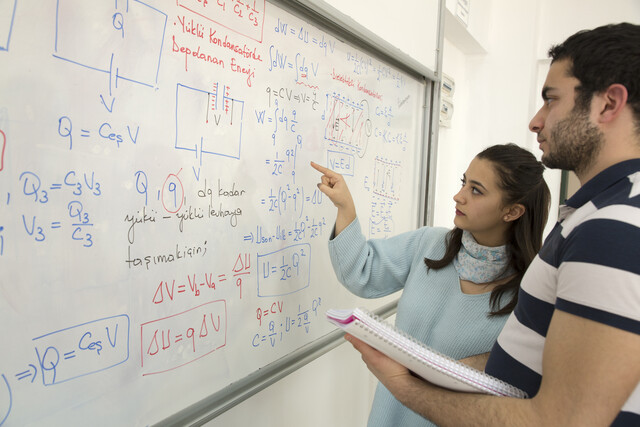

Today, much of technology and our lifestyles is brought to us by the laws of Physics, yet surprisingly, most people don't understand the fundamentals. Acoustics, astronomy, electromagnetism, electronics, nuclear power, optics, nanotechnology are just a few of the industries requiring an understanding of Physics. Join now and let's explore the natural laws of how the universe operates.
* Document your course completion with an online certificate (additional shipping/handling charges apply for hard copy delivery). Instantly download, print, and share your certificate and CEUs once awarded. UniversalClass™ offers many wonderful learning tools to help you get the most out of your online course,
including an online portfolio service that manages all your course completions, and a Certificate Verification Service you can use so others may view and verify the authenticity of your awards.
Course Description - An Introduction to Physics
Welcome to the world of Physics! Here, we will explore the natural laws of how the universe operates. This introductory course covers all the fundamentals of Physics, and is comprehensive enough for students already familiar with the subject. Join now, and together we'll learn about momentum and energy, force and motion, gravity, particles, the five states of matter, temperature and heat, sound waves, electricity, magnetism, and light.
Today, much of technology and our lifestyles is brought to us by the laws of Physics, yet surprisingly, most people don't understand the fundamentals. Acoustics, astronomy, electromagnetism, electronics, nuclear power, optics, nanotechnology are just a few of the industries requiring an understanding of Physics.
Course Lessons
Lesson 1: Introduction to Physics
The modern advanced and complex our society becomes, the greater our need for a variety of different types of energy sources. In simpler times, energy was something derived from rubbing two sticks together to create fire.
Lesson 2: Mechanics of Measurement
Despite the vast array of specializations that presently exist, covering everything from acoustics to thermal dynamics, physicists--regardless of their area of expertise--utilize a core continuum of practices.
Lesson 3: Momentum and Energy
Momentum can be defined as 'mass in motion'. This is equally true, for all objects have mass- hence, if an object is in motion then it has momentum-and if it is momentum, by and large, it is 'mass in motion.'
Lesson 4: Force and Motion (Newton's Laws of Motion)
Back in the late 1600s, Sir Isaac Newton, one of the most notable scientists and mathematicians in history published his now legendary 'Laws of Motion' within his book entitled, Philosophiae Naturalis Principia Mathematica. Since, the laws formed the basi
Lesson 5: Gravity
Whatever goes up-must come down. This famous statement refers to the basic tenets of gravity, hence, an explanation as to why objects fall to Earth.
Lesson 6: Systems of Many Particles
With respect to objects of noticeable size, we work with them by envisioning that they are made up of numerous smaller pieces-these then are referred to as 'particles.'
Lesson 7: Solids
While you have probably studied or learned about solids as they relate to chemistry; when applied to physics, the subject of solids focuses more on the bulk matter as opposed to the individual particles that comprise it.
Lesson 8: Gases and Liquids
Within the previous chapter, we touched upon the three (well, primarily there are three) states in which a substance can be found: solid, liquid and gas.
Lesson 9: Temperature and Heat
Temperature is a central component within physics. In short, within physics, the transfer of energy, internally, from one part of substance to another, or, externally, from one body to another occurs on account of differences in temperature.
Lesson 10: Energy, Work, and Heat (Thermodynamics at work)
We cited the differences between heat and temperature, listed and described the range of measurement scales available to track temperature, and identified the different states (phases) substances which may be found based upon temperature factors and press
Lesson 11: Wave Motion
Waves can be found anywhere and everywhere. Consider for a moment several commonly found examples: sound waves (discussed in greater detail in the subsequent chapter), light waves, radio waves (frequency), telecommunication waves, and microwaves (seriousl
Lesson 12: Sound Waves
Fundamentally speaking, sound is a mechanical wave. Our ears have then been constructed as conduits as such waves--meaning they serve as receivers for the mechanical waves transmitted through the air from a specified point of origin.
Lesson 13: Static Electricity
Defined as the state in which electrical charges build up on the surface of a material, 'Static Electricity' received its name on account of the lack of a flowing current.
Lesson 14: Electrical Induction
Prior to even beginning to broach the subject of electrical induction, we first will need to define the individual components which comprise the state referred to as 'electrical induction.'
Lesson 15: Electrical Current
The scientific definition of 'electrical current' includes the concept of speed-meaning the rate at which the charge is moving (flow) through the channel.
Lesson 16: Electromagnetic Waves
Both electricity, e.g., your hair sticking straight up and magnetism can be static, e.g. a refrigerator magnet. However, when the two change or come together, they form a specific type of wave known as electromagnetic waves.
Lesson 17: Magnetic Effects of Current
Not only do electric currents flow through the universe but magnetic currents do, as well.
Lesson 18: Quantum Nature of Light
Whereas physics attempts to describe the rules as they apply to movement and matter; quantum physics tries to explain the behavior of even smaller particles in combination with movement. Such particles include things the likes of: electrons, protons, and
Lesson 19: Light as a Wave
While we touched on the nature of light, the varying types which exist along the electromagnetic spectrum and, even delved a bit into, the idea of light as a wave formation, we kept the crux of our discussion on the first two rather than heavily focusing
Optional Certificates Awarded
Certificate of Outstanding Achievement
Certificate of Academic Excellence
Certificate of Course Completion is earned after completing the course with 70% or higher.
In addition to the standard Certificate of Course Completion, Merit Awards may be issued by the instructor at his/her own discretion and are based on student achievement. Merit awards also incur an additional $30.00 processing fee that covers the customization, printing, and delivery of the award, as well as access to the UniversalClass™ Portfolio Service that documents your achievements online. Official Merit Awards have a serial number that verifies the authenticity of the award (great for employers to verify your achievement).
This is a non-credit course, and is provided for your personal enrichment.
This course is not intended to be a substitute for any state, government, licensing, or educational requirements.
Choose from 5 Payment Methods
Credit Card Online
Credit Card through FAX
Check/Money Order through Mail
Credit Card over the Phone
PayPal
To use any of these methods you must press the "Join this Course" button on this screen and go through the online registration process in order to generate the correct order form and correctly process your enrollment.
The observer, when he seems to himself to be observing a stone, is really, if physics is to be believed, observing the effects of the stone upon himself.
"All the lessons were written such that I, lacking any prior physics knowledge, had no difficulty understanding the subject matter discussed....I very much enjoyed the class, some parts of physics are no longer a secret to me!" -- Cindy H.
"I was completely in the dark about physics and was a little nervous about tackleing this subject. Now I have a lot better understanding.
...The instructor was very prompt on grading my exams and getting the results back to me. I am very glad that I took this course." -- Rodney C.
"I am generally well-pleased with the course." -- Michael D.
($65.00) CHEMISTRY: It is Not Your Great-Grandfather's Science Anymore Moving beyond the white lab coat and test tube specimen chemistry once was, the science now encompasses a diverse spectrum of branches and sub-divisions. more
($55.00) There have been few environmental issues that have polarized a nation as much as Global Warming. more
Other Related Classes in Physics
ABC's of Algebra This online class is intended for students who need to brush up, review or gather a basic understanding of how to perform Algebra operations. This course will benefit both current students and adults who need to know how to perform basic Algebra operatio...
Algebra 201: Beginner to Intermediate Level Beginner to Intermediate Algebra is intended for students who need to gather a basic understanding of how to perform Algebra operations. This course will benefit current students and adult learners who need to know how to perform basic Algebra operations...
Astronomy 101 The universe is comprised of infinite space both on Earth and beyond. It is quite illuminating to discover the expansiveness that can be found by studying the night skies and not only learning about the array of celestial objects that exist but also unde...
Basic Math 101 Fear fractions no more. And learn whether to add first or multiply first in a string of operations. Whether you are struggling with basic math functions in a course today, you are taking a new job that demands understanding of math, or you simply need to...
Biology 101 Biology 101 is an excellent learning resource for the college or pre-college student. This logical and easy to understand class is divided into self-paced lessons, complimented with well-written text, diagrams, pictures, critical-thinking assignments an...
Cell and Molecular Biology 101 From the laboratory to the real world, cell and molecular biology has a far-ranging impact upon everything from the environment to health and medical issues. Cell and molecular biology enables researchers to study the minute world of microbes and cells. ...
Chemistry 101 CHEMISTRY: It is Not Your Great-Grandfather's Science Anymore Moving beyond the white lab coat and test tube specimen chemistry once was, the science now encompasses a diverse spectrum of branches and sub-divisions. And, while it certainly is fascinat...
Cosmology 101 This course will provide you with a great amount of information about our world, our universe, and beyond our Milky Way. With our guidance, you will be able to investigate many fascinating theories and explore many exciting concepts regarding the histo...
Geography 101 Are you mystified by maps? Would you like to know how mountains are made? You can find out the answers to these questions by taking our Geography Course. In eleven easy lessons, you'll learn all about the different geographical features that make up our ...
Geology 101 Geology is the study of the world around us and the way it was formed. The study expands beyond the earth and includes the building blocks of the whole universe. Without the study of geology, it would have been very difficult to build the modern world ...
Geometry 101 This course will provide the learner with a better understanding of the underlying concepts of geometry. Through readings, lessons, quizzes and independent explorations, the learner will leave the course with more complete understanding of geometry and b...
Global Warming There have been few environmental issues that have polarized a nation as much as Global Warming. From those who predict that the Earth will eventually get so hot that it will self-incinerate to those who believe that the entire notion of a warming planet...
History of the Universe For many centuries, scientists generally held the belief that the Universe was truly infinite--it had neither a beginning nor an end. The question of how our Universe began is one of the fundamental questions that all peoples of all cultures have wondere...
Math Review 101 This course deals with the nuts and bolts of Math. Students will become equipped with a solid foundation of the mathematical tools required to solve more complex mathematical operations. This course would benefit any student (regardless of age) who req...
Meteorology Fundamentals Meteorology is a fascinating subject. Because of its very nature, it is never constant or boring. Studies and observations of weather and climate and its impact on humans and the environment offer everything from gorgeous sunsets to terrifying hurricanes...
Microbiology 101 The study of microbiology is extremely rewarding, leading to advances in the welfare of the environment as well as human populations. Pursuing this fascinating subject lead to such careers in biotechnology, pharmaceutical manufacturing, medical research...