
Online Class: Chemistry 101

no certificate
with CEU Certificate*
-
16Lessons
-
18Exams &
Assignments -
4,553Students
have taken this course -
20Hours
average time -
2.0CEUs
Course Description
Unlock the World Through Chemistry: A Concise Journey
Dive deep into the universe of chemistry, the silent orchestrator of life, progress, and innovation. Just as a poet deciphers the world through words, a chemist perceives it through elements and compounds. This course isn't just about learning chemistry, but understanding the intricate dance of molecules that choreographs our very existence and the world around us.
Do you realize that every breath you take, every bite of food you savor, or the device you're reading this on is a testament to the wonders of chemistry? Our body's functions, the digital landscapes of our computers, the transportation marvels, and even the strong and secure roofs over our heads—everything leans on the principles of chemistry.
With recent studies in 2023 suggesting that the realm of applied chemistry is only expanding, it becomes even more vital to grasp its foundations. This is not just another course, but your gateway to interpreting the world in its most elemental form.
Course Breakdown:
-
Lesson 1: The Building Blocks - Atoms, Molecules, and Ions. Understand the alphabet of the chemical language.
-
Lesson 2: Chemical Foundations. Set the stage for deeper explorations by mastering the basics.
-
Lesson 3: Stoichiometry. Delve into the art of balancing, the backbone of all chemical equations.
-
Lesson 4: Chemical Reactions & Solution Stoichiometry. Explore the dynamic changes and understand their impacts.
-
Lesson 5: The Ethereal World of Gases. Unpack the mysteries of the airy substances around and within us.
-
Lesson 6: Thermochemistry. Warm up to the heat, and cool down with the intricacies of energy changes.
-
Lesson 7: Atomic Structure and Periodicity. Tour the periodic table and meet the elemental residents.
-
Lesson 8: Bonding - The Chemical Ties. Explore the connections that hold the world together.
-
Lesson 9: Valence Bond Theory. Dive deeper into the bonds and their distinct natures.
-
Lesson 10: Properties and Solutions. Discover the behaviors and interactions of chemical entities.
-
Lesson 11: Chemical Kinetics. Understand the pace and speed of chemical transformations.
-
Lesson 12: Chemical Equilibrium. Balance the scales of dynamic reactions.
-
Lesson 13: Spontaneity, Entropy, and Free Energy. Delve into the driving forces of reactions.
-
Lesson 14: The Nucleus - A Chemist's Perspective. Unearth the core and its profound implications.
-
Lesson 15: Dazzling World of Transition Metals & Coordination Chemistry. Understand the versatile players of the chemical realm.
-
Lesson 16: Organic Chemistry. Embark on a journey through the chemistry of life, exploring the carbon-based wonders.
Each lesson is meticulously crafted, brimming with interactive assignments, engaging polls, comprehensive exams, and informative documents to ensure a holistic understanding. Unlock the doors to a world where every element has a story, every reaction an emotion, and every molecule a secret. Enroll now and embark on this transformative journey!
Course Motivation
Believe me when I say - There's nothing nerdy about chemistry!
Despite the stereotyping of chemistry as a dry, boring area of scientific study, more and more people (both young and old) are striking out in this active and exciting field in an effort to make their own marks.
In fact, today the science of chemistry has grown to encompass a wide spectrum of divisions and sub-divisions. However, despite the diversity of specializations (physical chemistry, organic chemistry, etc.) there is a core foundation of ideas, principles and techniques that apply across the board.
In this course, you’ll gain a comfortable familiarity with these basics. Beginning with atoms and molecules (the building blocks of EVERYTHING in existence) and progressing on to the laws of conservation of matter and energy (which basically states that nothing truly disappears, it’s either transferred to another object or absorbed), you’ll gain a comprehensive knowledge of what chemistry is and how it can be put to work for you.
In the end, you’ll have gained new mastery that will prepare you to take in new ideas, theories and principles without risking loosing sight of chemistry’s basic tenets.
Forget about the intimidation factor of universities, professors or tying to juggle your schedule around set times and mandatory participation dates. Self-paced and self-contained, the only thing you need to bring with you to the table is an open mind (and at least a 10th grade reading level.) Fourteen lessons later, you'll have the foundation you need to build a solid interest (perhaps even solid career potential) in the field of chemistry.
You’d be amazed at the number of things that the science of chemistry encompasses:
- Atoms and molecules
- Matter and energy
- Chemical bonding
- Acids and bases
- Equilibrium
- Electrochemistry and
- Thermodynamics
- What chemistry is, why it’s important, the different branches and how chemistry is both similar to and different from biology
- An understanding of the origins of chemistry from the 18th century on
- The components, properties and changes of matter and energy
- Atomic scale structure and interactions
- The added stability inherent in chemical bonding
- Descriptions and properties of the three states of matter
- The three characteristics of gasses
- Solutions: Different Solvents and Concentrations
- Acids vs. bases and the chemists who defined them
- The properties, composition and reactions of carbon and hydrogen
- Oxidation and the balance between lost and gained electrons
- Electricity and the chemical changes that can result
- Chemical reactions and reactionary conditions
- Plus an understanding of the movement of energy AND how energy results in movement.
- Completely Online
- Self-Paced
- 6 Months to Complete
- 24/7 Availability
- Start Anytime
- PC & Mac Compatible
- Android & iOS Friendly
- Accredited CEUs
Course Lessons


Lesson 1. Atoms, Molecules, and Ions
 Lesson 1 Video
 Lesson discussions: Reasons for Taking this Course
 Complete Assignment: Introduce Yourself
- Assessment: Lesson 1 Exam
Lesson 2. Chemical Foundations
- Lesson 2 Video
- Assessment: Lesson 2 Exam
Lesson 3. Stoichiometry
- Lesson 3 Video
- Assessment: Lesson 3 Exam
Lesson 4. Types of Chemical Reactions and Solution Stoichiometry
- Lesson 4 Video
- Assessment: Lesson 4 Exam
Lesson 5. Gases
- Lesson 5 Video
- Assessment: Lesson 5 Exam
Lesson 6. Thermochemistry
- Lesson 6 Video
- Assessment: Lesson 6 Exam
Lesson 7. Atomic Structure and Periodicity
- Lesson 7 Video
- Assessment: Lesson 7 Exam
Lesson 8. Bonding. General Concepts
- Lesson 8 Video
- Assessment: Lesson 8 Exam
Lesson 9. Valence Bond Theory
- Lesson 9 Video
- Assessment: Lesson 9 Exam
Lesson 10. Properties and Solutions
- Lesson 10 Video
- Assessment: Lesson 10 Exam
Lesson 11. Chemical Kinetics
- Lesson 11 Video
- Assessment: Lesson 11 Exam
Lesson 12. Chemical Equilibrium
- Lesson 12 Video
- Assessment: Lesson 12 Exam
Lesson 13. Spontaneity, Entropy, and Free Energy
- Lesson 13 Video
- Assessment: Lesson 13 Exam
Lesson 14. The Nucleus, A Chemist's View
- Lesson 14 Video
- Assessment: Lesson 14 Exam
Lesson 15. Transition Metals and Coordination Chemistry
- Lesson 15 Video
- Assessment: Lesson 15 Exam
Lesson 16. Organic Chemistry
- Lesson 16 Video
- Lesson discussions: End of Course Poll; Program Evaluation Follow-up Survey (End of Course); Course Comments
- Assessment: Lesson 16 Exam
- Assessment: The Final Exam
Learning Outcomes
- Define atoms, molecules, and ions.
- Describe chemical foundations and stoichiometry.
- Identify gases and thermochemistry.
- Describe atomic structure and periodicity.
- Describe bonding and the Valence Bond Theory.
- Summarize properties and solutions.
- Describe chemical equilibrium.
- Summarize spontaneity, entropy, and free energy.
- Summarize the nucleus, a chemist's view.
- Summarize transition metals and coordination chemistry.
- Summarize organic chemistry.
- Demonstrate mastery of lesson content at levels of 70% or higher.
Additional Course Information
- Document Your Lifelong Learning Achievements
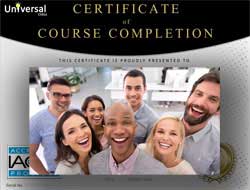
- Earn an Official Certificate Documenting Course Hours and CEUs
- Verify Your Certificate with a Unique Serial Number Online
- View and Share Your Certificate Online or Download/Print as PDF
- Display Your Certificate on Your Resume and Promote Your Achievements Using Social Media

Choose Your Subscription Plan
No Certificate / No CEUs
This course only
| Includes certificate | X |
| Includes CEUs | X |
| Self-paced |

|
| Instructor support |
|
| Time to complete | 6 months |
| No. of courses | 1 course |
Certificate & CEUs
This course only
| Includes certificate |
|
| Includes CEUs |
|
| Self-paced |
|
| Instructor support |
|
| Time to complete | 6 months |
| No. of courses | 1 course |
Certificates & CEUs
Includes all 600+ courses
| Includes certificate |
|
| Includes CEUs |
|
| Self-paced |
|
| Instructor support |
|
| Time to complete | 12 Months |
| No. of courses | 600+ |
Certificates & CEUs
Includes all 600+ courses
| Includes certificate |
|
| Includes CEUs |
|
| Self-paced |
|
| Instructor support |
|
| Time to complete | 24 Months |
| No. of courses | 600+ |
Student Testimonials
- "The instructor was good. She graded assignments and exams in a timely manner. She also gave feedback on things that I missed and explained what I did wrong." -- Olivia S.
- "This instructor is wonderful. I appreciated her feedback and interest in me as a student. I have studied Ecology and Geology with her in the past, and now I am studying Marine Biology." -- Judith J.
- "She is very knowledgeable, and good on what she teach." -- Jhornalize M.
- "Thanks, I enjoyed learning from you." -- Ken P.
- "I am satisfied with the course I want to continue on." -- Viera V.
- "She was prompt with all grading and any questions I had. It was a 101 course and offered a well rounded experience. It gave me more background on how I was using chem. in my wastewater, water operations." -- Tim M.
- "The instructor was very helpful and available. She is very knowledgeable. This was an EXCELLENT course." -- Donna N.
Related Courses
-
 74 hours
7.4 CEUs
Medical Billing and Coding Course Bundle
+ More Info
74 hours
7.4 CEUs
Medical Billing and Coding Course Bundle
+ More Info
-
 8 hours
0.8 CEUs
Geology 101
+ More Info
8 hours
0.8 CEUs
Geology 101
+ More Info
-
 18 hours
1.8 CEUs
Medical Terminology 101
+ More Info
18 hours
1.8 CEUs
Medical Terminology 101
+ More Info
-
 35 hours
3.5 CEUs
Biology 101
+ More Info
35 hours
3.5 CEUs
Biology 101
+ More Info
-
 7 hours
0.7 CEUs
Understanding Concussions
+ More Info
7 hours
0.7 CEUs
Understanding Concussions
+ More Info
-
 9 hours
0.9 CEUs
Marine Biology 101
+ More Info
9 hours
0.9 CEUs
Marine Biology 101
+ More Info
-
 7 hours
0.7 CEUs
Geography 101
+ More Info
7 hours
0.7 CEUs
Geography 101
+ More Info
-
 9 hours
0.9 CEUs
Meteorology Fundamentals
+ More Info
9 hours
0.9 CEUs
Meteorology Fundamentals
+ More Info
-
 18 hours
1.8 CEUs
Introduction to Cell and Molecular Biology
+ More Info
18 hours
1.8 CEUs
Introduction to Cell and Molecular Biology
+ More Info
-
 6 hours
0.6 CEUs
HIPAA Compliance 101
+ More Info
6 hours
0.6 CEUs
HIPAA Compliance 101
+ More Info
-
 14 hours
1.4 CEUs
Ecology 101
+ More Info
14 hours
1.4 CEUs
Ecology 101
+ More Info
-
 7 hours
0.7 CEUs
Astronomy 101
+ More Info
7 hours
0.7 CEUs
Astronomy 101
+ More Info
-
 7 hours
0.7 CEUs
History of the Universe
+ More Info
7 hours
0.7 CEUs
History of the Universe
+ More Info
Loading...



Follow Us Online